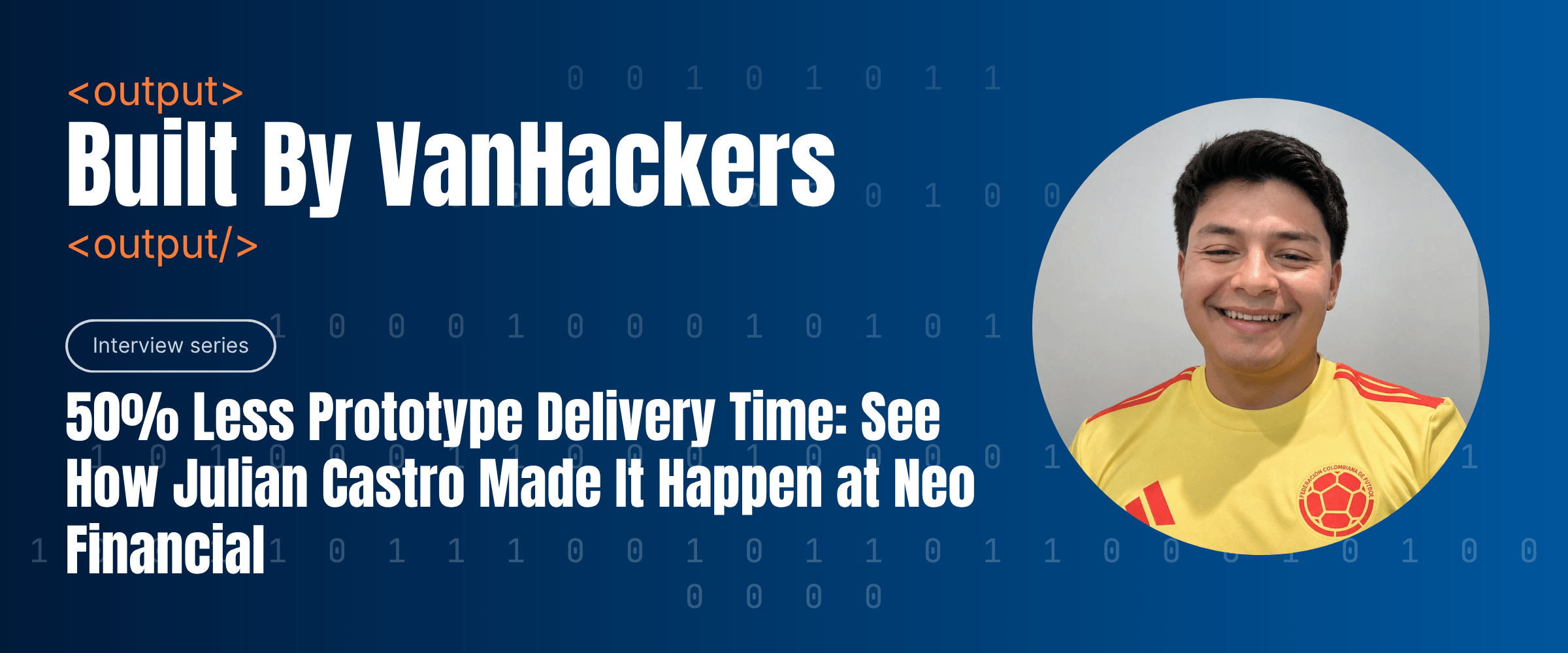
Julian Castro joined Neo Financial through VanHack as a senior full-stack developer. Today, he is part of a fast-moving fintech team using AI-assisted engineering to build new banking product experiences with more speed, structure, and focus.
Neo Financial is a Calgary-based fintech company building spending, saving, credit, borrowing, and investing tools for Canadians. Julian describes the company as a startup trying to improve the way banking services are delivered in Canada, with a development culture where speed and automation matter every day.
That pace shaped Julian’s work almost immediately. In the interview, he explained that the team was working on new product prototypes and future financial services, using reusable building blocks so one project could help accelerate the next one.
From Colombia to a Canadian fintech team
Julian introduced himself as a senior software developer from Colombia with around eight years of experience as a full-stack developer. At Neo Financial, he works mainly with TypeScript and contributes to product work inside a fast-growing engineering environment.
For companies hiring through VanHack, this is the kind of story that matters after the offer is signed. The impact is not only that someone relocated or joined a new team. The impact shows up in the product work they help move forward.
In Julian’s case, that work sits at the intersection of fintech, full-stack development, product thinking, and AI-assisted engineering.
The shift behind the speed: thinking before typing
One of the biggest changes Julian described was not simply using AI to write code faster. It was changing how engineers spend their attention before the first line of code is written.
Instead of treating development as manual implementation from start to finish, Julian said the work now begins with a clearer definition of the problem: what the team is trying to deliver, what the desired outcome should be, and how available tools can help automate the lower-level pieces.
That point is important because it explains the numbers that come later. The productivity gains are not only about producing more code. They come from combining stronger problem framing, reusable building blocks, AI-supported implementation, human review, and product context.
For a fintech team building sensitive financial products, that distinction matters. AI can help accelerate implementation, but the engineering value comes from knowing what to build, how to structure it, and how to keep the work aligned with the product goal.
More ready code, faster delivery cycles
When asked about measurable outcomes, Julian pointed to productivity and delivery speed. He estimated that the team now produces around 35% to 40% more code, or more ready code, than with previous methods.
The reason was not just raw output. He connected the improvement to a workflow where code can be generated, reviewed, deleted, delivered, and tested faster. That matters because useful engineering velocity is not measured by code volume alone. It is measured by how quickly a team can move reliable work toward a real product outcome.
“Now we deliver at least 35% to 40% more code, or more ready code, than in the past.”
That is a meaningful result for a company building in a competitive fintech market.
A prototype timeline cut roughly in half
Julian also gave a concrete delivery example from a new product prototype. At the beginning, the timeline felt extremely tight. The team expected that building the feature with older methods could have taken around five sprints.
Using the team’s AI-assisted development approach, the work took about two and a half sprints. Julian described that as roughly a 50% time saving, and possibly more, depending on how the comparison is framed.
“Without these tools, it would probably take five sprints. With this, it took two and a half. I would say around 50% saving time.”
The important point is not that AI replaces engineering judgment. Julian’s story shows the opposite. The team could move faster because engineers were combining better problem definition, reusable building blocks, and AI-supported implementation with human review and product context.
That is especially relevant in fintech, where speed alone is not enough. The best engineering teams need to move quickly while still protecting quality, security, and customer trust.

Building reusable foundations for future products
Julian also emphasized that the prototype work was not isolated. The team was trying to build from reusable pieces so the effort could support more products in the future.
That approach is valuable because one well-built foundation can reduce the effort required for the next product. Instead of treating every new financial service as a standalone build, the team can reuse patterns, components, and technical decisions that already proved useful.
For a growing company, that is where senior full-stack talent can make a difference. The work is not only about delivering one feature. It is about creating building blocks that help the company keep delivering.
What this says about global fintech talent
Julian’s Built By VanHackers story is a clear example of why global hiring matters for technical teams. A senior developer from Colombia joined a Canadian fintech company and began contributing to product work in a high-speed, AI-enabled engineering environment.
The value shows up in practical ways: stronger problem framing, faster delivery cycles, more ready code, and reusable foundations for future product development.
For employers, the lesson is simple. The right engineering talent may not be in the same city, province, or country as the hiring team. With VanHack, companies can reach senior technical professionals who are ready to contribute to real product outcomes after they join.
For candidates, Julian’s advice is equally direct: trust your skills, prepare properly, and keep applying for the opportunities that match your ambition.
That is the heart of Built By VanHackers: the value does not stop at the hire. It shows up in the products, systems, and faster-moving teams that talented people help build after they arrive.