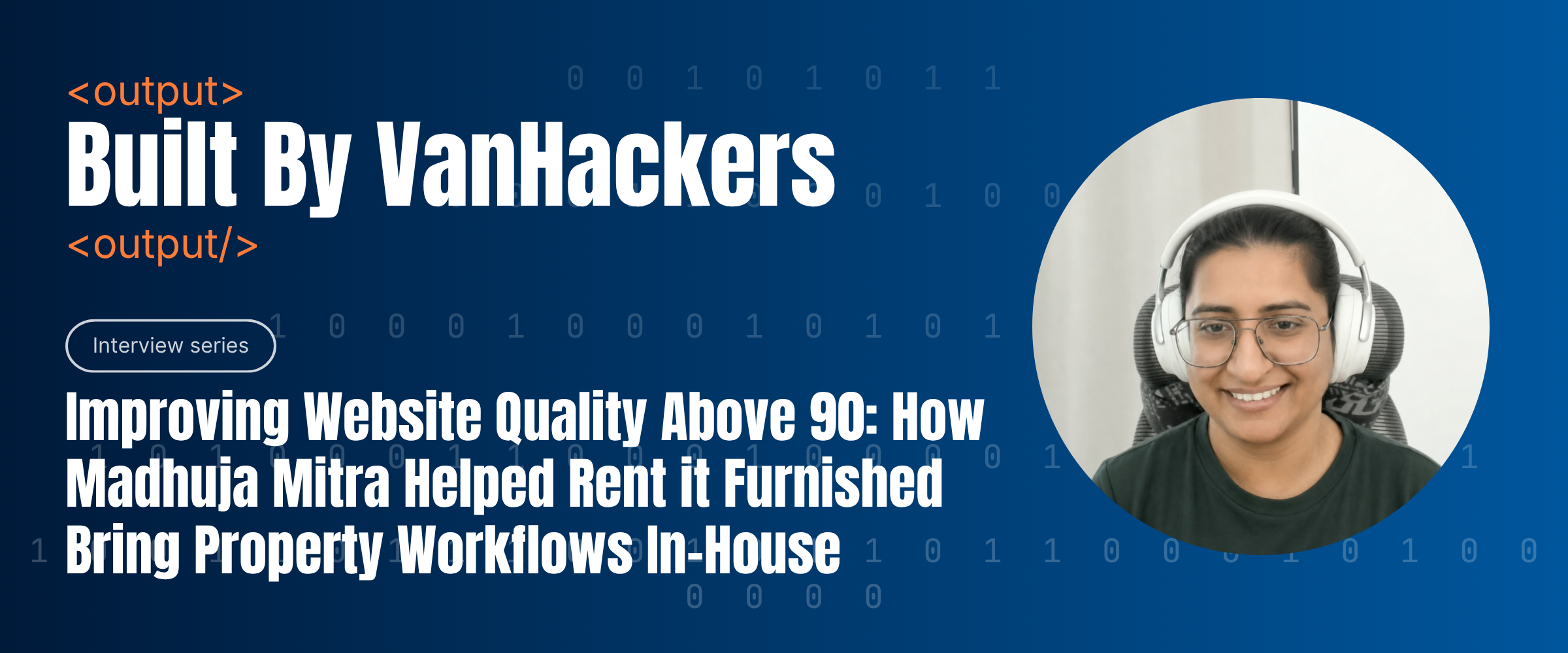
Madhuja Mitra joined Rent it Furnished through VanHack as a frontend developer. Within months, her role expanded into full-stack product work across internal tools, customer-facing portals, integrations, migrations, and usability improvements.
Rent it Furnished provides luxury rental property, property management, and investment real estate services across markets including Vancouver, Toronto, Montreal, Ottawa, and New York.
Behind that service model is a growing software need. Realtors, property managers, owners, and tenants all depend on accurate information, simpler workflows, and clear visibility into what is happening across the rental process.
That is where Madhuja’s story stands out. She was hired for frontend development, but her impact quickly moved beyond one layer of the product. In the interview, she says her work now spans Python, Java, React, Next.js, AWS, internal CRM systems, customer-facing portals, integrations, migrations, and usability improvements.
From frontend hire to full-stack contributor
Madhuja describes her role evolution clearly: she joined as a frontend developer, then quickly grew into full-stack development as the company needed support across more of its product environment.
That shift matters because the company’s software work was not limited to one page or one isolated feature. Madhuja talks about improving both internal systems and customer-facing experiences, helping the business make its platform more usable for the people who rely on it every day.
For a real estate services company building more of its operations into software, that kind of range is valuable. The work is not only about writing code. It is about reducing friction between business processes, third-party tools, and the platform people actually use.
Improving website quality above 90
Madhuja pointed first to website quality. She said she worked on accessibility, SEO, performance, load times, and the friction between the build process and the application.
The clearest number in the interview came from that work: SEO and accessibility scores above 90. For a company whose customer journey depends on people finding properties, exploring services, and completing key actions online, those improvements support a smoother digital experience.
“Now the SEO is quite high, above 90. Even the accessibility, performance, and reduced load times improved.”
Better SEO supports discoverability. Better accessibility makes the experience more usable. Faster load times reduce friction for visitors and customers using the site.
Building a data integration from scratch
One of the most concrete projects Madhuja describes is a web scraping and data integration project she built from scratch.
The business needed information from a third-party tool, but the API was not exposed. Instead of asking internal users to leave the platform, go into another system, collect the result, and bring it back manually, Madhuja built a way to pull that data directly into the Rent it Furnished environment.
That is the kind of product work that can look small from the outside but feel meaningful inside the business. When information is available in the right place, users move faster, the workflow becomes clearer, and the platform becomes more central to daily operations.
Madhuja also framed this as a usability improvement. The goal was not only to connect systems. It was to let people complete more of the work from one platform instead of jumping between disconnected tools.
Bringing workflows in-house and reducing outside-tool costs
Madhuja’s impact also extended into migration work. In the interview, she describes bringing inspection-related work that had previously depended on SafetyCulture into the company’s own platform.
The product value was clear: users could manage more of their work in one place. The business value was also clear: the company reduced monthly external subscription costs and kept more of the workflow inside its own system.
“The credit check part is actually bringing revenue. The SafetyCulture migration decreased the extra payment the company was doing every month.”
Madhuja was not only improving screens or adding features. She was helping create revenue-connected functionality and lowering recurring tool spend.
For a property management platform, that kind of consolidation matters. Owners, tenants, realtors, and property managers each need different views of the same operation. If the product can bring more of that work into one system, it reduces the need for disconnected tools and manual follow-up.
A more automated platform for property operations
Madhuja describes Rent it Furnished as a company that has been building out a software suite for realtors, property managers, owners, and tenants.
In that suite, owners and tenants can see how money moves each month, maintain profiles, apply through the system, and rely on more automated processes. The goal is not to remove the human side of property management, but to make the digital side easier to manage.
That is what makes the work product-led: it connects technical decisions to how people actually use the business. Better performance, in-house workflows, integrated data, and fewer external tools all point toward the same outcome: a platform that is easier to use and more useful to the business.

A hiring process that felt clear and responsive
Before joining Rent it Furnished, Madhuja was applying through different portals, including LinkedIn. What stood out about VanHack was visibility.
She says the process made it clear where her application stood, how the interview process was moving, and when feedback was available. She also remembers the process as personal and responsive, especially because her recruiting contact kept her updated while the role moved forward.
When asked to summarize the experience, three words came to mind: smooth, fast, and responsive.
She also noticed the AI assessment process as a way to help companies evaluate candidates faster and narrow the pool more efficiently.
Why verified global talent matters
Madhuja’s advice to companies is simple: look beyond local borders when the right talent may be somewhere else.
In her view, the value of a platform like VanHack is that companies can access global candidates who are already going through a verification process and are open to international opportunities.
Her own story shows what can happen after that match is made. A frontend hire becomes a full-stack contributor. Website quality improves above 90. A third-party workflow becomes part of the internal platform. Revenue-connected functionality is created. Monthly external-tool spend is reduced. Product usability gets stronger.
That is the heart of Built By VanHackers: the value does not stop at the hire. It shows up in the systems, workflows, and product experiences that talented people help build after they join.