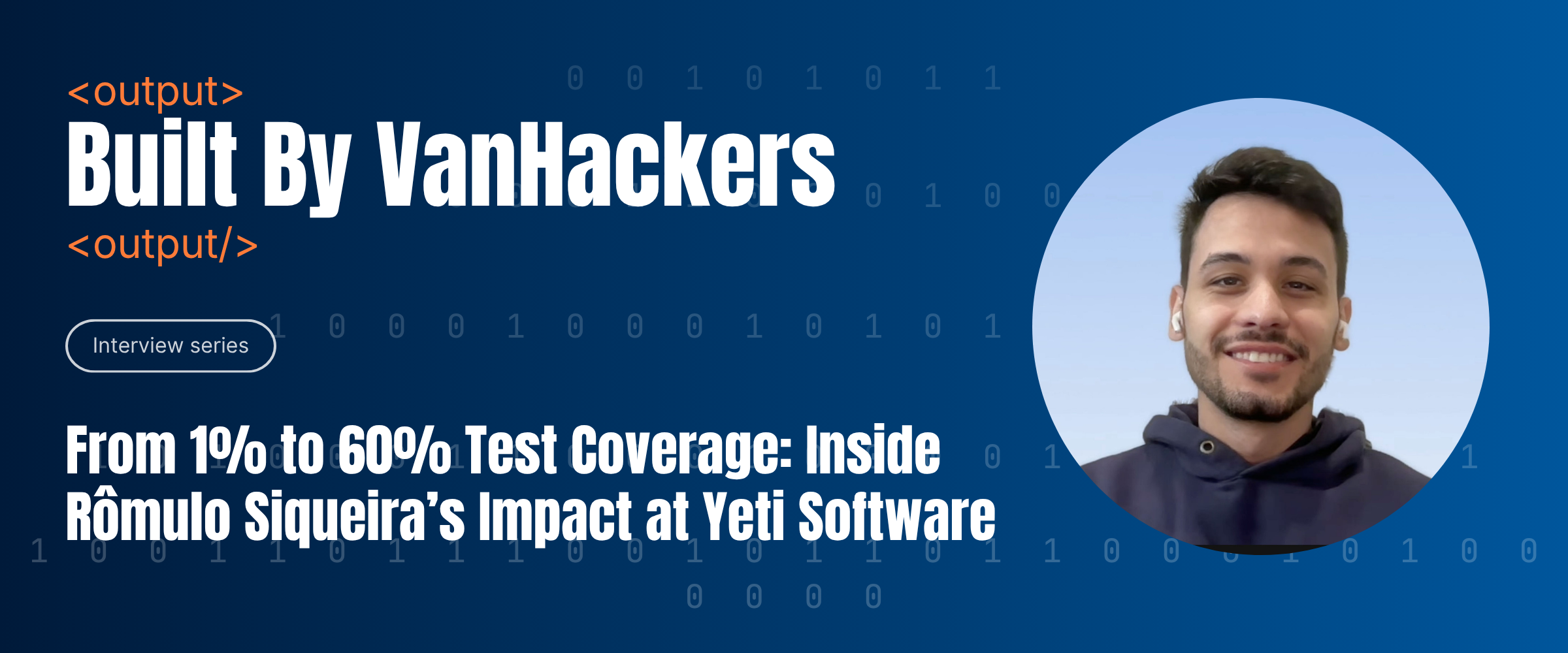
Yeti Software builds operations software for snow removal and lawn care companies, helping teams manage crews, jobs, dispatch, routing, site photos, quoting, billing, and reporting in one platform.
For a field-service SaaS platform, engineering quality is not invisible. It shapes how confidently the team can ship improvements, how safely the product can evolve, and how well customers can rely on the system during busy operating seasons.
That is where Rômulo’s work stands out. A software engineer with 17 years of experience, he says he found the Canadian opportunity through VanHack. Since joining Yeti Software, his impact has shown up in concrete numbers: backend test coverage raised from nearly 1% to 60%, more than 100 security vulnerabilities addressed, and a back-office tool that helped the team move 20 of 100 test clients into a subscription plan.
From 1% to 60%: rebuilding the backend foundation
When Rômulo joined the team, one of the biggest engineering challenges was not a new feature. It was the foundation behind the product. The backend had almost no automated test coverage, which made every future improvement harder to ship with confidence.
Rômulo led a focused effort to improve that foundation. In the interview, he explains that test coverage moved from nearly 1% to 60%, with the team still working toward a higher long-term target.
“When I got into the company, the test coverage of the backend was nearly 1%. I made a run to improve that coverage, and I got it up to 60%.”
For a growing SaaS product, that kind of improvement changes the way engineering work happens. Better coverage gives the team more confidence to modernize, fix, and extend the platform without creating unnecessary risk.
100+ vulnerabilities fixed through modernization
The test-coverage work became even more important during a major Laravel and PHP modernization. Rômulo says he helped move the backend from Laravel 8 to a newer Laravel version and upgraded the PHP runtime from 7.4 to a modern version.
The upgrade was not only about keeping the stack current. Older versions were no longer receiving the same security updates, and that created risk for the platform. Rômulo says the modernization helped fix more than 100 vulnerabilities that could have affected the product.
“By improving that, we fixed more than 100 vulnerabilities that could affect our platform.”
This is the type of product work customers may never see directly but benefit from constantly: fewer risks, a more maintainable codebase, and a stronger foundation for future development.
A back-office tool that made customer engagement visible
Rômulo’s impact also extended beyond backend modernization. He built a back-office tool to help the team manage users and understand how customers were engaging with the platform.
The tool used an Angular front end and a Laravel API, giving the team clearer visibility into client metrics. In the transcript, Rômulo says that visibility helped the team move 20 of 100 test clients into a subscription plan.
For a SaaS team, that kind of internal tool can become a growth lever. When teams understand how customers are using the product, they can make better decisions about engagement, onboarding, and the moments that lead users toward paid adoption.

AI habits before AI features
Rômulo has also helped Yeti Software build new habits around AI. Starting in January, he launched an internal initiative to help the team get more comfortable using AI in daily work.
That initiative includes a weekly lunch-and-learn and a Slack channel where the team shares knowledge, techniques, and prompts. The focus is practical: making AI useful in the team’s day-to-day workflow before deciding which ideas should become product features.
He says the team is also exploring three AI MVPs this quarter. One possible project focuses on customer onboarding, where he believes automation could help reduce a process that can take about two weeks today to something closer to three to five days if the MVP proves successful.
“I started this in January, and for this quarter we plan to have three MVP projects using AI.”
Because those projects are still MVPs, the outcome should be treated as a future possibility rather than a finished result. But the direction matters: Rômulo is helping the team build both technical systems and operating habits that can make product innovation faster.
Engineering talent that compounds inside the product
The strongest Built By VanHackers stories are not only about someone getting hired. They are about what happens after the hire.
At Yeti Software, Rômulo’s work shows how a strong engineering hire can compound across a product organization: more test coverage, fewer security risks, better internal tooling, clearer customer metrics, and a team that is beginning to experiment with AI in a structured way.
That is the value VanHack aims to make possible: helping companies connect with technical talent who do not just join the team, but help build what the business needs next.