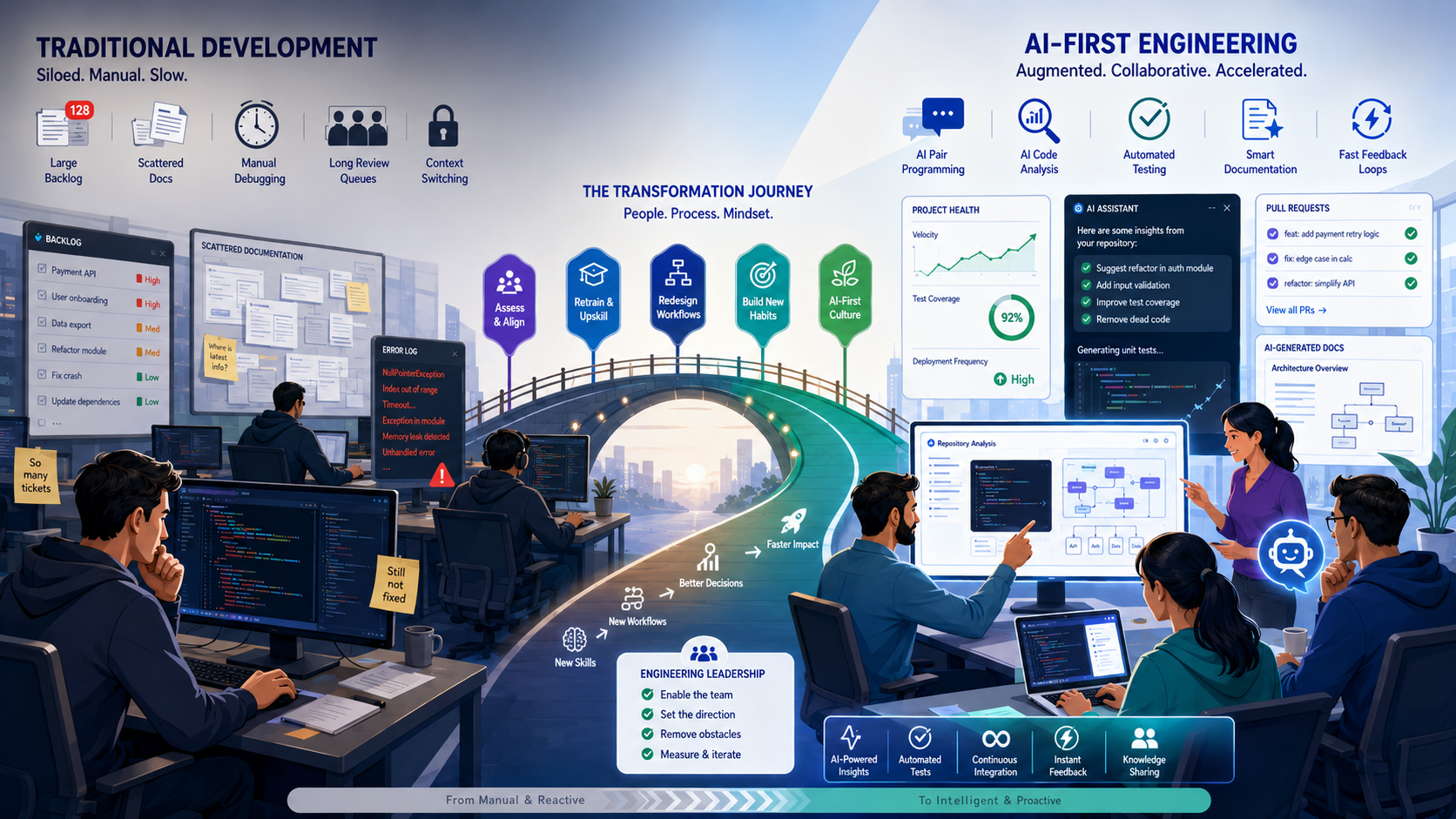
The Gap CEOs Are Seeing
Companies are spending real money on AI developer tools. GitHub Copilot licenses, Cursor subscriptions, Claude Code access, internal tooling budgets. And yet, in engineering standups and sprint reviews, the workflow looks almost identical to 2021.
Most developers are using AI the way they used Stack Overflow: paste a question, grab a snippet, move on. They are not using it to plan features, debug system-level issues, generate test suites, refactor legacy code, or document decisions. The tool is there. The behavior has not changed.
AI-first engineering is not about replacing developers. It is about retraining the workflow around what AI can now do.
That retraining will not happen on its own. It requires deliberate action from engineering leadership and buy-in from the CEO level down.
What an AI-First Developer Team Actually Means
Before you can close the gap, you need to define the target. AI-first does not mean handing your codebase to an agent and reviewing the output once a week. That is reckless, and most experienced engineers know it.
AI-first means developers use AI assistance across the full software development lifecycle, not just at the autocomplete layer. This includes:
- Reading and summarizing unfamiliar code
- Generating and maintaining test coverage
- Refactoring and migrating legacy modules
- Debugging with structured reasoning, not trial and error
- Summarizing pull requests and documenting architectural decisions
- Exploring multiple implementation approaches before committing to one
Human engineers still own the decisions that matter most: system architecture, product judgment, security posture, and final code quality. AI accelerates the execution layer. Engineers elevate to the direction layer.
Audit Where Your Team Is Today
Most engineering teams sit somewhere on a five-level maturity ladder. Before rolling out any retraining program, you need an honest review of where your team currently stands.
Level 1: No AI use
Developers are not using AI tools in their workflow at all, either by personal preference or lack of approved access.
Level 2: Autocomplete and chat prompts
Developers use AI occasionally for quick answers or inline code suggestions, but treat it as a search engine with better formatting.
Level 3: AI for snippets and explanations
Developers ask AI to explain error messages, generate boilerplate, or suggest syntax. Usage is reactive and task-scoped.
Level 4: AI agents for real coding tasks
Developers are starting to delegate meaningful work: generating tests, drafting components, exploring refactor options. But usage is individual and inconsistent across the team.
Level 5: AI-first workflows with standards
The team has agreed-upon norms for how AI is used in planning, coding, testing, and review. Output quality is measured. Prompting practices are shared and improved over time.
Most teams that think they are at Level 4 are actually at Level 3. Audit honestly.
Start With Workflow, Not Tool Choice
The tool debate is a distraction. Whether your team uses GitHub Copilot’s coding agent, Claude Code, Cursor, or OpenAI Codex matters far less than whether your team has the specs, tests, documentation, and review processes that make any AI tool actually useful.
AI tools fall into a few broad categories:
- IDE copilots: Inline suggestions and chat inside the editor (Copilot, Cursor)
- Terminal agents: Command-line AI that can read repos, run tests, and make changes (Claude Code)
- Cloud coding agents: Browser or API-based agents for larger autonomous tasks
- PR agents: Tools that summarize, review, or generate pull request content
Pick a category that fits your team’s current workflow. Then build the habits that make it produce reliable output.
Retrain Developers Around Five New Habits
This is where the real leverage is. Five behavioral changes will take a team from AI-occasional to AI-first.
1. Write better task briefs
Vague prompts produce vague code. Teach developers to give AI the context it needs to do the job well: the goal, the constraints, the relevant files, the acceptance criteria, and the edge cases to handle. A well-structured brief takes three minutes to write and saves thirty minutes of back-and-forth output review.
2. Ask AI to inspect before it codes
Developers conditioned to type “build this” into an agent will get plausible but often misaligned code. Change the default to: read the repo first, identify existing patterns and constraints, propose a plan, then execute. This one habit dramatically reduces hallucinated implementations.
3. Delegate first drafts
AI is well-suited to producing first drafts: scaffolding new modules, generating migration scripts, writing initial test suites, reproducing bug conditions, drafting documentation, and sketching refactor plans. Engineers should be reviewing and shaping these drafts, not generating them from scratch.
4. Make AI verify its own work
Before an agent hands back output, require it to run the relevant tests, explain any failures, and summarize what changed and why. Agents that self-verify catch a meaningful percentage of their own errors before a human has to.
5. Review AI output like a junior developer wrote it
AI can move fast. Senior engineers still need to review for logic errors, security vulnerabilities, UX edge cases, and long-term maintainability. The review standard should be higher than for trusted teammates, not lower.
Build Guardrails So AI Use Becomes Safe
AI-first does not mean AI-unsupervised. Teams that move fast without guardrails accumulate technical debt faster than any pre-AI team could manage. Establish clear rules upfront:
- Define and communicate approved tools by use case
- Never include secrets or credentials in prompts
- All AI-assisted work happens on branches, not directly on main
- Pull requests require human review before merge, regardless of AI involvement
- Test gates must pass before any AI-generated code ships
- Security checks apply to AI output the same as any other code
- Production code standards do not change because AI wrote the first draft
Document these rules. Put them in your engineering handbook. Make them part of onboarding.
Change the Culture, Not Just the Stack
Some developers will resist. Not because they are lazy, but because they are worried. They think AI threatens their value, introduces quality risk, or produces code that is harder to maintain than what they would write themselves. Some of those concerns are valid.
Reframe the conversation. The engineers who thrive in an AI-first environment are not the ones who type the fastest. They are the ones who can write precise specs, spot architectural problems, catch subtle security issues, and make good product judgment calls. AI makes those skills more valuable, not less.
To accelerate culture change:
- Run weekly AI pairing sessions where developers work through real tickets together using agents
- Build an internal prompt library with high-performing task briefs the team can reuse and improve
- Hold monthly demo days where developers share what AI workflows saved them the most time
- Identify two or three AI champions on the team who can coach peers and surface blockers
A 30-Day Retraining Plan
Week 1: Baseline and approve
Survey the team to understand current AI usage. Identify where the team sits on the maturity ladder. Finalize and communicate approved tools and guardrails. Make sure everyone has access to what they are supposed to use.
Week 2: Daily workflow drills
Run structured AI workflow drills on small, low-risk tickets. Focus on building the habit of writing task briefs, inspecting before coding, and verifying output. Keep it lightweight. The goal is repetition, not perfection.
Week 3: Require AI assistance on selected PRs
For a defined subset of pull requests, require that AI was used for at least one of the following: test generation, documentation, debugging, or refactoring. Review these PRs together to surface what worked and what did not.
Week 4: Standardize what works
Take the workflows, prompts, and review patterns that produced the best results and formalize them as team standards. Update your engineering handbook. Assign ownership. Set a cadence for ongoing refinement.
What to Measure
Avoid vanity metrics. Lines of code generated tells you nothing useful. Focus on outcomes that reflect real engineering productivity:
- Ticket-to-prototype time: How long does it take to go from a written spec to a working proof of concept?
- PR cycle time: Are pull requests moving through review faster?
- Test coverage: Is AI-assisted development increasing or decreasing coverage?
- Bug recurrence: Are AI-generated fixes holding, or creating new problems?
- Refactor backlog: Is the team making progress on technical debt it previously could not touch?
- Onboarding speed: Can new engineers ramp up faster when AI tools are embedded in the workflow?
- Developer confidence: Are engineers reporting that they feel more capable with agents than without?
Run a short pulse survey at the end of Week 4. Then again at 90 days. The qualitative data matters as much as the quantitative.
AI-First Is a Management Shift, Not Just a Tech Upgrade
CEOs and CTOs cannot buy AI tools and wait for transformation to happen. The tools are necessary, but they are not sufficient. What actually changes a team’s output is changing how the team thinks about work: what gets delegated to an agent, what gets reviewed by a human, what gets documented as a standard, and what gets measured as a result.
The engineering teams winning right now are not necessarily the ones with the biggest AI budgets. They are the ones whose leaders made a deliberate decision to retrain expectations, workflows, review standards, and hiring criteria around what AI can now do.
That decision starts at the top.
If your team is moving AI-first, hire developers who can adapt quickly to modern engineering workflows.